

Most people know obesity can increase the risk of diabetes, heart disease, and high blood pressure. But there’s another health issue that often flies under the radar hernias.
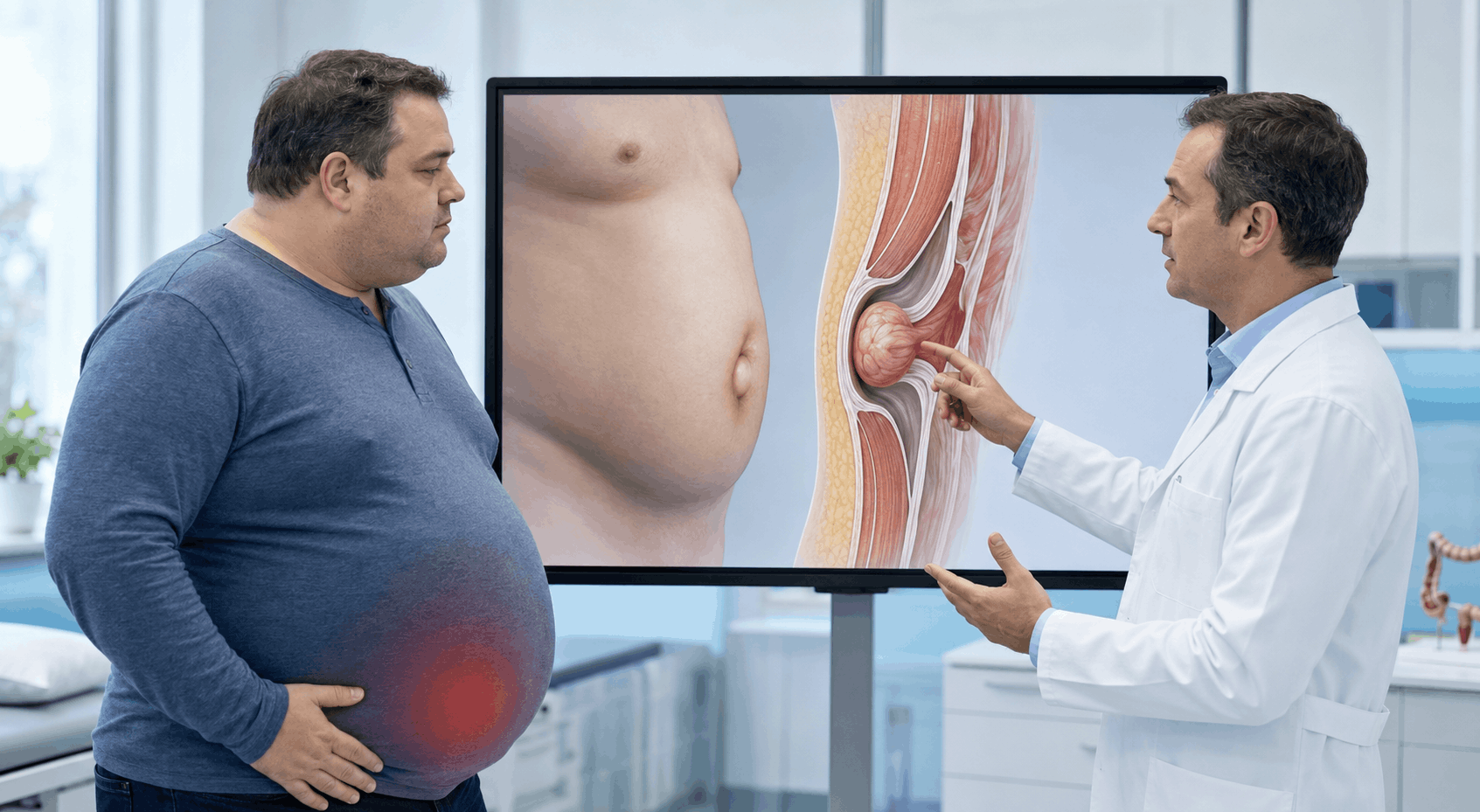
Carrying extra weight doesn’t just put stress on your knees or back. It also places constant pressure on the muscles of your abdomen. Over time, that pressure can weaken the abdominal wall, making it easier for a hernia to develop.
The good news? Understanding the connection between obesity and hernias can help you take action before the problem becomes more serious.
Why Does Extra Weight Increase Hernia Risk?
Your abdominal muscles work every day to support your organs and maintain core strength. When you gain excess weight, especially around the stomach, these muscles face continuous strain.
Think of it like stretching a rubber band. The more pressure it handles over time, the weaker it becomes.
As the abdominal wall weakens, a section of tissue or an organ can push through the muscle, creating a hernia. This is why obesity is considered one of the major risk factors for several types of hernias, including inguinal, umbilical, and incisional hernias.
The heavier a person becomes, the greater the pressure inside the abdomen, which increases the chances of developing this condition.
Surgery Can Be More Challenging
Obesity doesn’t just increase the risk of developing a hernia, it can also make surgery more complex.
Extra body weight may increase the chances of wound infections, slower healing, and hernia recurrence after surgery. That’s why many surgeons encourage patients to adopt healthier lifestyle habits before and after treatment whenever possible.
Fortunately, modern minimally invasive techniques have improved outcomes for many patients, even those with higher body weight.
This is one reason why many people seek specialized Hernia Treatment in India, where experienced surgical teams use advanced technology to deliver safe and effective care.
Can Weight Loss Help?
Yes, absolutely, losing even a modest amount of weight can reduce pressure on the abdominal wall and improve overall health. Regular physical activity, balanced nutrition, and maintaining a healthy weight may lower the risk of developing a hernia and improve recovery after surgery.
However, weight loss alone cannot repair an existing hernia. Once a hernia forms, it usually requires surgical treatment to fix the weakened muscle.
If you notice a bulge, pain, or discomfort, don’t wait for it to become an emergency. Early evaluation often leads to simpler treatment and better outcomes.
Expert Hernia Care at Kaizen Hospital
Choosing the right hospital plays an important role in successful hernia treatment. Established in 2011, Kaizen Hospital was founded with a vision to deliver world-class healthcare in Ahmedabad through advanced medical technology, research, skilled professionals, and patient-focused care. Today, it is recognized as one of Western India’s first and largest gastroenterology super-specialty hospitals.
As a NABH-accredited healthcare institution, Kaizen Hospital offers specialized gastrointestinal services supported by experienced gastroenterologists and expert gastro surgeons. The hospital is equipped with Gujarat’s first Visera Elite III installation and provides advanced minimally invasive laparoscopic procedures for various gastrointestinal conditions, including hernias.
If you’re looking for reliable Hernia Treatment in India, Kaizen Hospital combines modern surgical expertise, cutting-edge technology, and compassionate care to help patients recover safely and return to their everyday lives with confidence.